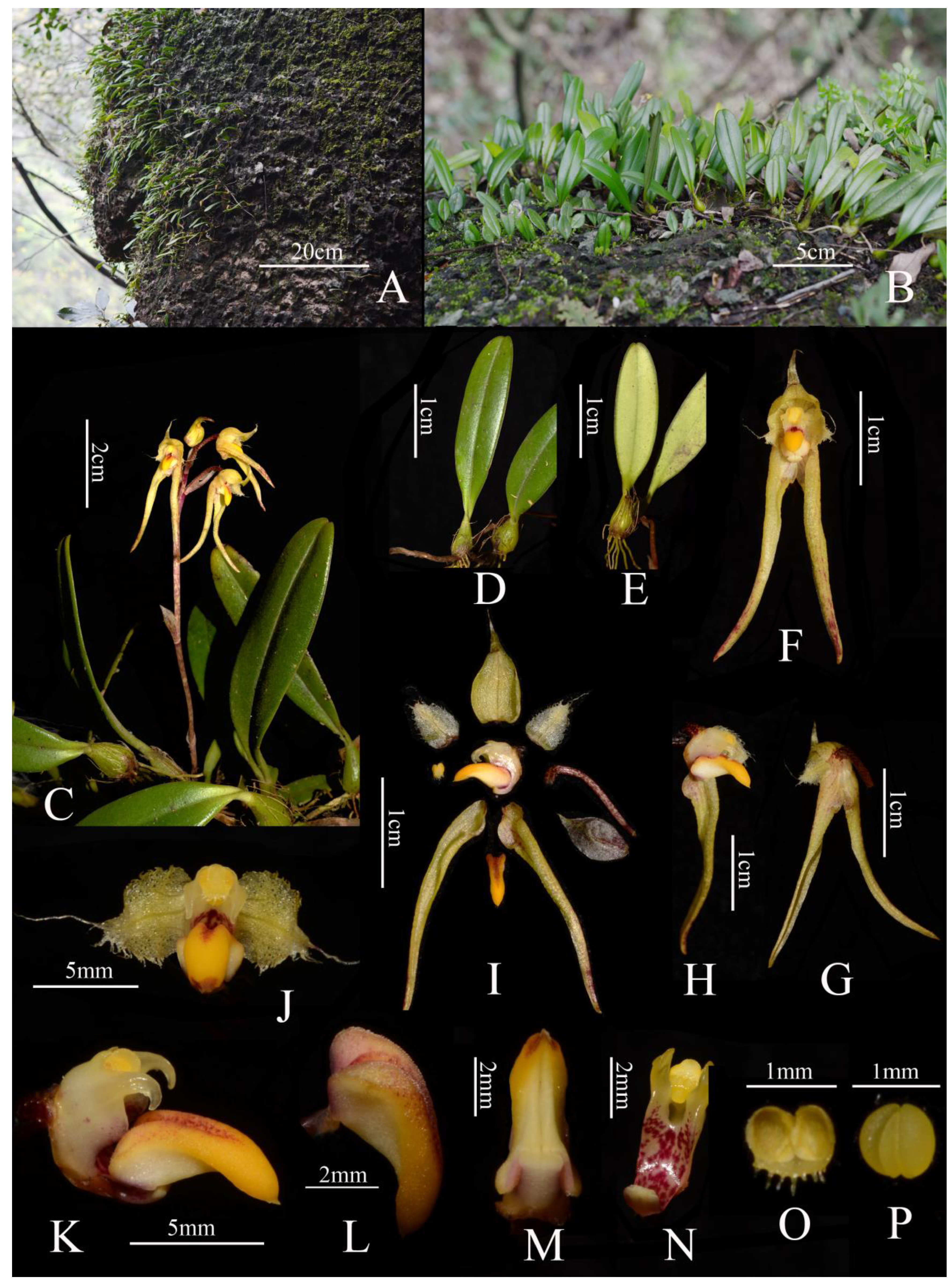
FIGURE 1.
Bulbophyllum hamatum
.
A
: Habitat;
B
: Individuals of a subpopulation;
C
: Flowering plant;
D-E
: Leaves and pseudobulbs;
F
: Flower, front view;
G
: Flower, ventral view;
H
: Lateral sepal, lip and column, side view;
I
: Anatomy of the flower;
J
: Petal, lip and column, front view;
K
: lip and column, side view;
L
: Lip, side view;
M
: Lip, ventral view;
N
: Column, ventral view;
O
: Anther cap;
P
: Pollinia.
Description
.
Epiphytic or lithophytic herb.
Rhizome
creeping,
quantity2 mm
in diam., rooting from base of pseudobulbs.
Pseudobulbs
quantity1–7 cm
apart on rhizome, narrowly pyriform to subcylindric,
quantity1–2.5 cm
,
quantity0.3–1.2 cm
in diam., with a terminal leaf.
Petiole
quantity1–2 cm
;
leaf
oblong, 3–8.5 ×
quantity0.7–1.6 cm
, thick, leathery, base cuneate, apex obtuse and retuse, mid-vine concave adaxialy, convex abaxialy.
Scape
arising from base of pseudobulb, erect, usually
quantity5–9 cm
; condensed
raceme
2–4-flowered;
peduncle
slender, ca.
quantity1 mm
in diam., 2 or 3 tubular sheaths, placed sparsely; floral
bracts
ovate, cymbiform,
quantity8–12 mm
.
Pedicel
and
ovary
quantity1.2–2 cm
, densely purple spotted.
Flowers
yellowish white.
Dorsal sepal
broadly ovate, 6–10 ×
quantity5 mm
, apex long acuminate to caudate, margin entire, 4–5-veined;
lateral sepals
usually free, narrowly falcate-lanceolate, 16–22 ×
quantity5 mm
, base adnate to column foot, margin entire, twisted near base and divergent, apex acuminate.
Petals
ovate or ovate-triangular, 5 ×
quantity4 mm
, tip caudate with a thread
quantity2–3 mm
, margins finely erose to deeply lacerate distally, 3-veined;
lip
recurved, ligulate, ca.
quantity6 mm
, fleshy, base attached to end of column foot by a mobile joint, apex obtuse and apiculate, sparsely finely papillate on both sides.
Column
ca.
quantity5 mm
, with ovoid wings at upper part;
foot
curved, ca.
quantity4mm
, with free part ca.
quantity3 mm
;
stelidia
hooked or falcate, ca.
quantity2 mm
;
anther cap
comblike on apical margin;
pollinia
4, in 2 pairs.
Distribution and habitat
.
B. hamatum
grows in Wufeng County,
collectingRegionHubei
,
collectingCountryChina
, on damp moss rocks and trees in the subtropical evergreen broad-leaved forest at the elevation
quantity950–1200 m
. Three subpopulations were found around the
typeStatustype
locality.
Taxonomic note
:
B. hamatum
mainly differs from
B. omerandrum
in hooked or falcate stelidia. The morphological differences between them were summarized in
Table 1
and
Fig. 2
.