Type: —
| Key | Value |
|---|---|
| id | ABD87F022C272A7AFF7B8A5FFD624C06 |
| ID-GBIF-Occurrence | 3392777301 |
| collectingDate | 2019-06-13 |
| collectionCode | KUN |
| collectorName | Q. Liu |
| country | China |
| elevation | 2932 |
| latitude | 31.466476 |
| location | alpine grasslands in Jinhou hill |
| longitude | 110.31236 |
| municipality | Shennongjia Forest District |
| specimenCode | KUN1498244 |
| specimenCount | 1 |
| stateProvince | Hubei |
| typeStatus | holotype |
| Key | Value |
|---|---|
| id | ABD87F022C272A7AFD058A7BFC794C05 |
| ID-GBIF-Occurrence | 3392777302 |
| collectingDate | 2019-06-13 |
| collectionCode | KUN |
| collectorName | Q. Liu |
| country | China |
| elevation | 2932 |
| latitude | 31.466476 |
| location | alpine grasslands in Jinhou hill |
| longitude | 110.31236 |
| municipality | Shennongjia Forest District |
| specimenCode | KUN1498245 |
| specimenCount | 1 |
| stateProvince | Hubei |
| typeStatus | isotype |
Diagnosis:— Potentilla sunhangii is similar to P. saundersiana , from which it is distinguished by many granular glands on both the abaxial and adaxial sides of leaves, sepals, epi-sepals and stipule, and leaf blade sparse appressed sericeous.
FIGURE 2 . a. Bayesian consensus tree of Potentilla based on nuclear ITS data; b. Bayesian consensus tree of Potentilla based on plastid trnL + trnL-F data. Numbers following names are the last two digits of accession numbers (Table S2), numbers in branches indicate Bayesian posterior probability (PP).
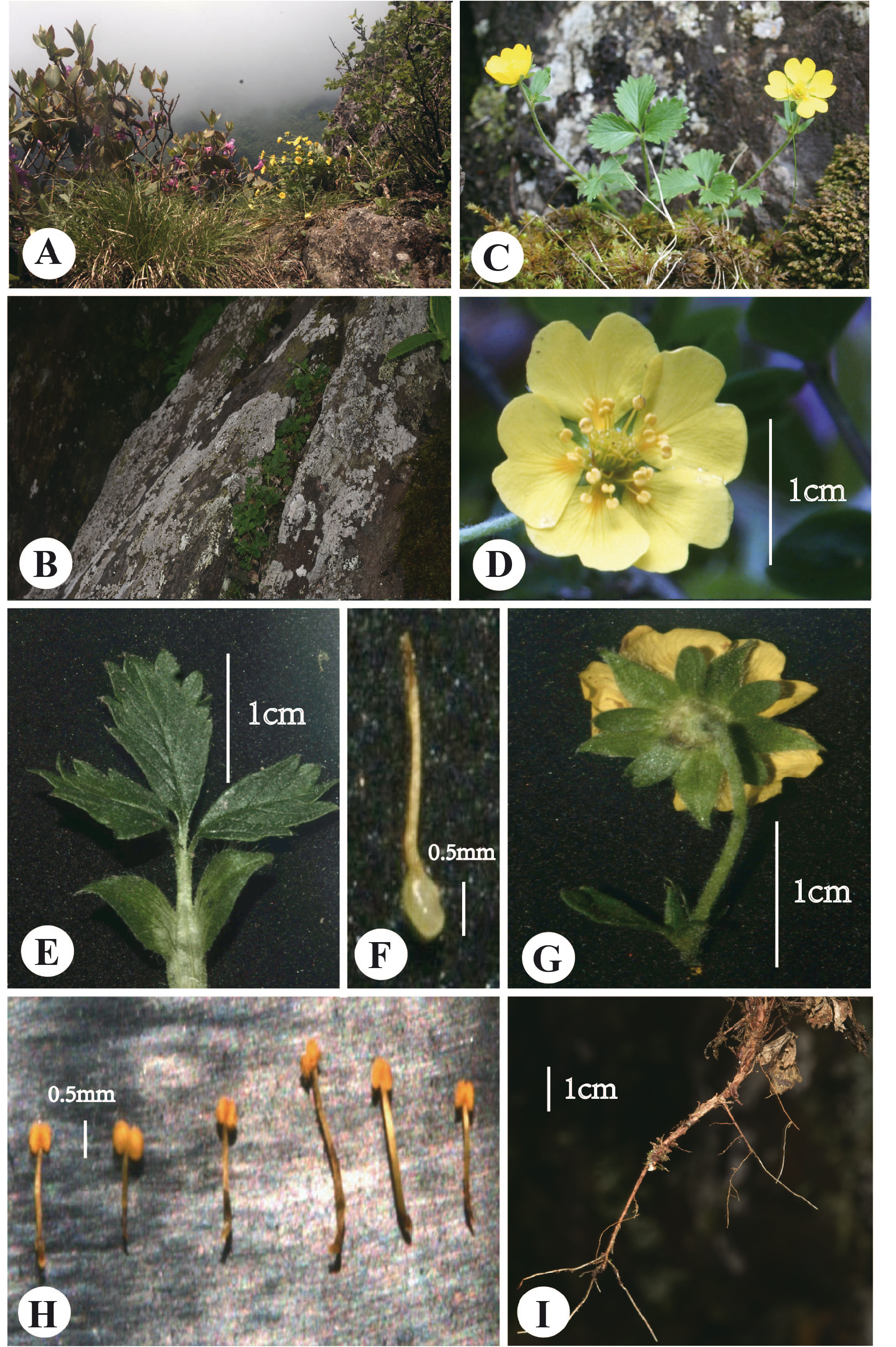
FIGURE 3 . Potentilla sunhangii . A. habit in the Jin-hou-ling Mountains, Shennongjia; B. habit in rocks in Jin-hou-ling Mountains; C. flowers (in June); D. flower in front view; E. upper surface of basal leaves, showing leaflet number and teeth; F. stigma and style; G. flower in side view showing dense pubescence on the pedicel; H. part of stamens; I. root.
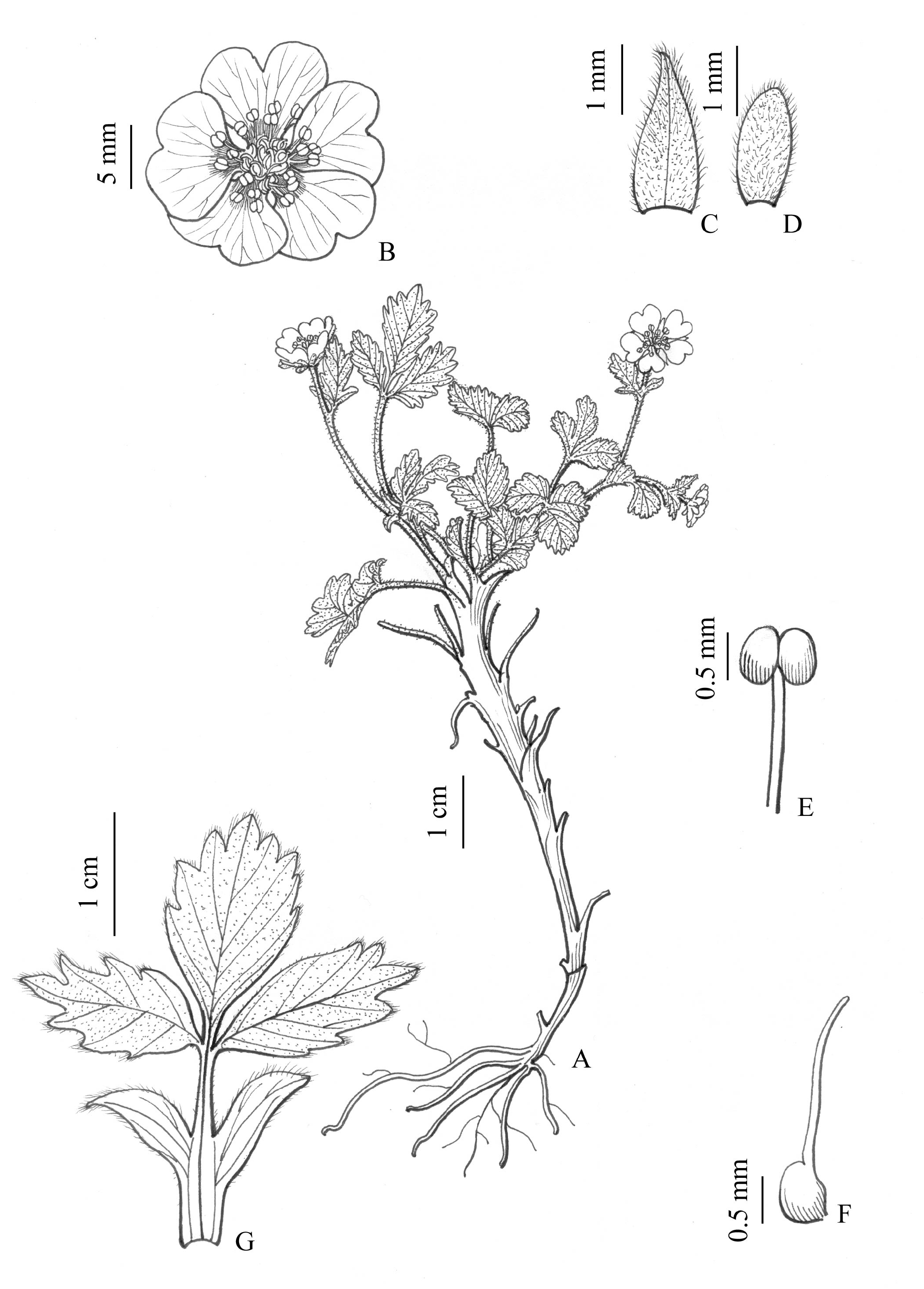
FIGURE 4 . Illustration of the holotype of Potentilla sunhangii . A. Habit (perennial herb); B. Flower in front view; C. Sepal; D. Episepal; E. Anther with two thecae; F. Oval with lateral style; G. Cauline leaves with ventral stipular auricles.
Description: —Herbs perennial. Root terete, slender, with brown remaining stipules, membranous. Flowering stem erect, single or 2–3 cluster, quantity6–10 cm tall, with white long pubescence. Radical leaves palmately 3 foliolate, quantity1.5–4 cm including petiole. Petioles with white long pubescence, mid leaflet ovalellipsoidal, lateral leaflets obliquely ovoid, length and width are nearly equal, quantity0.6–1cm , apex obtuse, base cuneata or truncate, margin obtusely 10–12 serrate on side, green on both surfaces, both sides of leaflets with sparse pubescence and sticky glands. Cauline leaves 1–2, leaflets resembling those of radical leaves, smaller. Radical leaves stipule brown, membranous, with sparse pubescence. Cauline leaves, only radical concrescent with petiole, stipules grayish green, oval, obtuse, with sparse pubescence and granular glands. Inflorescence corymbose cyme, 1–3 flowered, pedicel quantity1.5–2 cm , densely with long pubescence and glands. Flowers diameter 1.5 cm-sepals long triangle, apex taper, episepals elliptic lanceolate, apex obtuse, abaxially sparsely pubescent and stick glands. Petals yellow, obcordate, apex micro concave, stamens ca. 20, filaments sparsely with pubescence, carpels 20, ovary sparsely pubescence, styles subterminal, base thickened, stigma bending.
Distribution and habitat: — P. sunhangii is known only in Jin-hou-ling moutains, Shennongjia Fostery District, collectingRegionHubei , collectingCountryChina ( Fig. 5 ). The terrain is mountainous with deep ravines and the climate is subtropical monsoon climate. The species is alpine herbs, which distributed in relatively drought alpine grassland meadow even in rock crevices.
Etymology: — Potentilla sunhangii is named in honor of Prof. Hang Sun, a Chinese botanist who has made significant contributions to the flora of collectingCountryChina and research on Biogeography.