TABLE 1. Summarized comparative measurements and scale counts of Arrhyton . An asterisk indicates a subcaudal count that corresponds to a tail with a missing tip (see Hedges & Garrido 1992 ).
( Figs. 1–7 )
| Key | Value |
|---|---|
| id | E5883C8AFF962476FF37FBD2593AFBB4 |
| ID-GBIF-Occurrence | 3387243301 |
| collectingDate | 2010-01 |
| collectionCode | WGS |
| collectorName | Alexis Silva Garcia & Jose Raul Suarez Bauza |
| county | Juvenile |
| latitude | 21.105862 |
| location | Cueva de los Panaderos |
| longitude | -76.13822 |
| municipality | Gibara |
| specimenCode | MHNHCu 6000 |
| specimenCount | 1 |
| stateProvince | Holguin |
| typeStatus | holotype |
Diagnosis . A species of the genus Arrhyton , related to A. redimitum , as shown in the molecular phylogeny of Fig. 3 . It can be distinguished from other species of the genus by the combination of (1) a wide immaculate white neck band or collar; (2) faint body stripes on a gray to grayish-tan background; (3) a solidly black and sharply defined cephalic pattern (“cap”, sensu Schwartz 1965 ), surrounded by whitish gray; (4) a short and solidly pigmented dark stripe crossing the eye, interrupted posteriorly by the white neck band, (5) a mucronate rostral scale (see Discussion), (6) high number of ventral scales (145), and high number of subcaudal scales (132).
Most Arrhyton species have basically three well-defined body stripes on a tan or brown background, but there is variation in this character and two additional paravertebral stripes may be present depending on the species, giving some taxa a quinquelineate pattern ( Fig. 1B–H ). Arrhyton albicollum sp. nov. is closely related to A. redimitum . Juveniles of A. redimitum may have a pair of small occipital spots interrupted by the middorsal stripe or show narrow post-occipital indentations of the paler colored areas on either side of the middorsal stripe that abruptly disconnect the paravertebral stripes from the cephalic pattern ( Figs. 1B and 2B–D ). The cephalic “cap” is dark brown, generally paler in the middle and outlined dark in adults. The dark stripe across the eye from the sides of snout is continuous with the lateral stripe on each side, running along the body to the tail. None of the available specimens of A. redimitum has a conical, abrupt, dark projection on the rostral scale. Like most A. redimitum , A. albicollum sp. nov. has a dark spot on each of the internasal scales and stippled first labials. The ventral scale count of A. albicollum sp. nov. (145) is within the range of A. redimitum . However, only the typeStatusholotype (MCZ 42505) of A. landoi (= A. redimitum ) has 150 ventrals, the remaining sampled individuals of this species have 110–144 (mean 128, n = 54) ventrals. The number of subcaudal scales of A. albicollum sp. nov. is higher than that of A. redimitum (63–125, mean 89, n = 44; specimens with missing tail tips were not included).
Arrhyton dolichura ( Figs. 1C and 2F ), A. procerum ( Figs. 1D and 2G ), and A. tanyplectum ( Figs. 1F and 2J, K ), have long tails which are 40–46% of the TL versus 25–40% of the TL of other species (39% in A. albicollum sp. nov. ). These snakes have well defined stripes, and usually a vivid yellow or cream coloration on the lower flanks and the belly. In none of them is the cephalic dorsal pattern or “cap” solid black (as in A. albicollum sp. nov. ) and the number of subcaudal scales of A. albicollum sp. nov. is in the range of A. tanyplectum ( Table 1 ). Arrhyton ainictum has a well-defined quinquelineate pattern, 137 ventrals ( vs . quantity145 in A. albicollum sp. nov. ), 108 subcaudals ( versus 132), and shorter tail which is 33% of TL ( vs . 39%).
Arrhyton vittatum ( Figs. 1G and 2L ) is easily distinguished from A. albicollum sp. nov. and the other species of Arrhyton in that it has a reddish brown coloration. The middorsal stripe may be absent, paler, or wider than those stripes on the flanks. Intercalated paravertebral stripes are sometimes slightly evident or generally absent in this species. The ventral coloration is pearl-white to iridescent grayish-pink. Juveniles may have some evidence of small occipital pale spots; the dark cephalic dorsal pattern is diffuse in adults (“soot-like”), not conspicuously surrounded by a distinctive pale coloration, and the snout is mostly pale brown. The number of ventral (107–123) and subcaudal (52–81) scales is notably lower than A. albicollum sp. nov. ( Table 1 ) and the tail is shorter, 29–33% TL ( vs . 39%).
Arrhyton supernum ( Figs. 1E and 2H ) has two occipital pale spots, instead of a broad white band, interrupted by the middorsal stripe; the overall coloration is dark brown, compared with the grayish color of A. albicollum sp. nov. , the number of ventral (124–128) and subcaudal (107–108) scales is much lower ( Table 1 ), and the tail is 26% TL ( vs . 39%).
Arrhyton taeniatum ( Figs. 1H and 2I ) is the largest species (up to quantity457 mm SVL, MNHNCu 4622) and it occurs syntopically with A. albicollum sp. nov. It is the only species which always lacks a loreal scale. It has wide body stripes that in some individuals are indistinct from the brown background, vivid yellow flanks and belly, the highest number of ventral scales (168–189, vs . quantity145 in A. albicollum sp. nov. ), a projected and upturned rostral scale, a laterally expanded head and smaller eyes which are far from the head outline when seen dorsally vs . larger and slightly protruded eyes from the head outline in A. albicollum sp. nov.
TABLE 1. Summarized comparative measurements and scale counts of Arrhyton . An asterisk indicates a subcaudal count that corresponds to a tail with a missing tip (see Hedges & Garrido 1992 ).
| Species | Maximum SVL (mm) | Maximum Ta (mm) | Ventral scales | Subcaudal scales |
|---|---|---|---|---|
| A. albicollum sp. nov. | 143.5 | 90.5 | 145 | 132 |
| A. redimitum | 250 | 158 | 115–150 | 69–125 |
| A. ainictum | 363 | 176 | 137 | 108 |
| A. dolichura | 282 | 200 | 123–132 | 101–127 |
| A. procerum | 267 | 211 | 142–145 | 137–140* |
| A. supernum | 255 | 171 | 124–128 | 107–108 |
| A. taeniatum | 457 | 150 | 168–189 | 73–99 |
| A. tanyplectum | 321 | 236 | 141–146 | 121–133 |
| A. vittatum | 207 | 87 | 107–123 | 52–81 |
Description of typeStatusholotype . See Fig. 4 for head scales. SVL quantity143.5 mm ; Ta quantity90.5 mm (39% TL), quantity234 mm TL. Head distinct from body; head length quantity8.6 mm (6% SVL), head width quantity5.5 mm (64% head length) at widest point, head height quantity3.5 mm at tallest point; interocular distance quantity3.7 mm (67% head width); snout-eye distance quantity2.2 mm (25% head length, HL); nostril-eye distance quantity1.5 mm ; rostral subtriangular, quantity1.9 mm wide and quantity1.2 mm high, well visible in dorsal view; prefrontal divided, quantity1.6 mm long (17% HL), 2.3 times longer than internasals; prefrontals not in contact with orbit, but instead contacting supraocular and upper half of the preocular; frontal subtriangular quantity2.5 mm long (29% HL) and quantity2.2 mm wide; supraocular quantity1.8 mm long (21% HL) and quantity0.9 mm wide, twice wider distally than proximally; parietals quantity3.4 mm long (39% HL), quantity2.4 mm wide; nasal divided; nostril horizontally oval, its posterior border lying on the nasal suture, but most of the opening is on the prenasal scale; prenasal scale quantity0.7 mm (8% HL); postnasal scale quantity0.6 mm (7% HL); loreal single, quadrangular, quantity0.6 mm long (7% HL) and quantity0.4 mm high; loreal contacting second supralabial; preocular single, two times higher than wide, entering orbit posteriorly; eye diameter quantity1.9 mm (22% HL), pupil round; postoculars 2/2, upper postocular twice higher than lower postocular; temporals 1+2+3 on both sides of head; supralabials 7/7, of which 3rd and 4th are in contact with the eye; 6th supralabial slightly tallest than 5th, both in contact with first temporal; infralabials 8/8, first pair in contact with mental, 1st to 3rd contacting first chinshields, 4th and 5th contacting second chinshields; dorsals smooth, rhomb shaped, with no pits externally visible; dorsal scales row formula 17–17–17; cloacal plate divided; number of ventral and subcaudal scales were already mentioned in the diagnosis; a terminal conical projection about five times longer than the two last subcaudals.
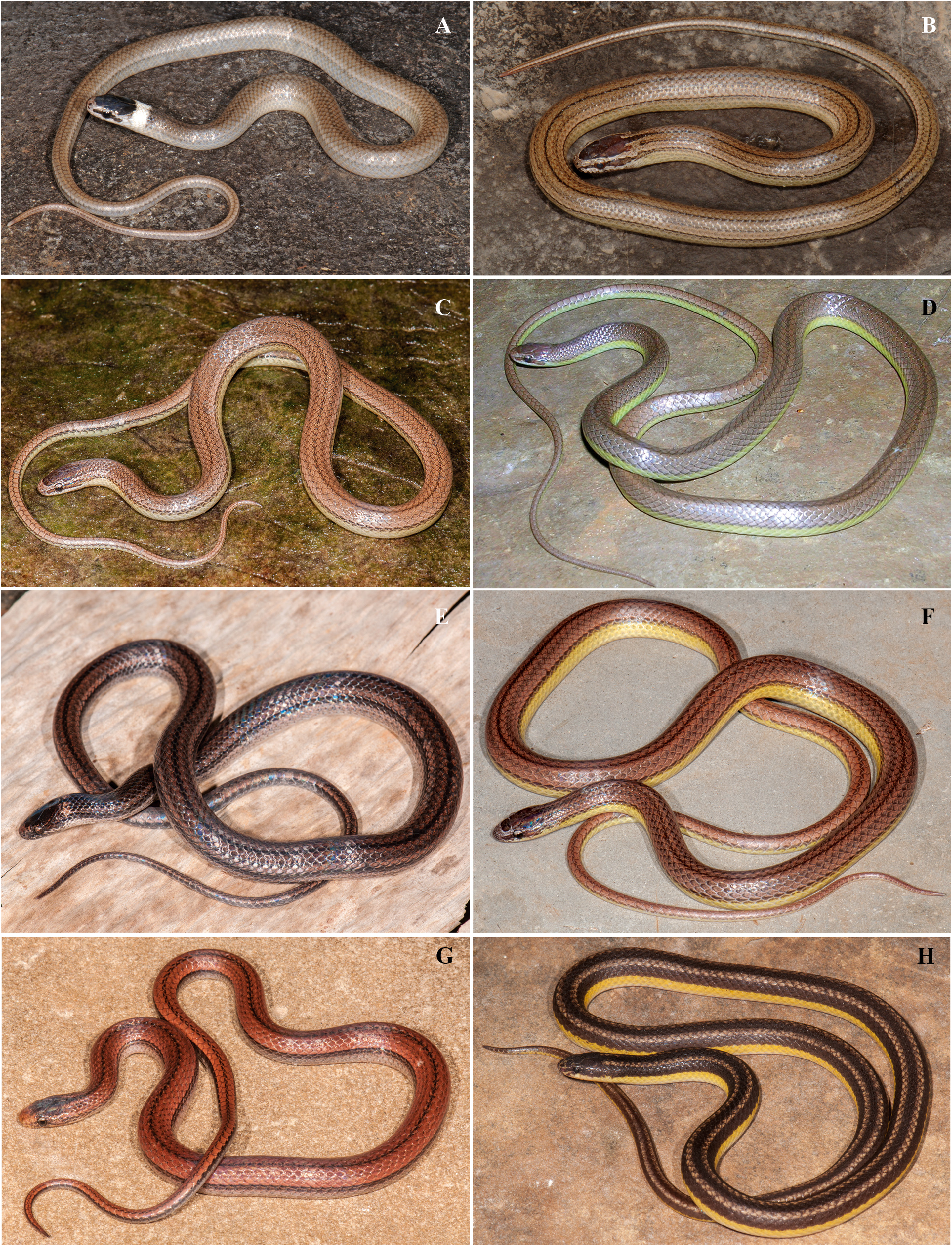
FIGURE 1 . Diversity of snakes of the genus Arrhyton . ( A ) A. albicollum sp. nov. , holotype (MNHNCu 6000) in life, from Gibara, Holguín; ( B ) A. redimitum , from Macambo, Guantánamo; ( C ) A. dolichura (DSP 8), from Rincón de Guanabo, La Habana; ( D ) A. procerum (MNHNCu 6001), Gironcito, Península de Zapata, Matanzas; ( E ) A. supernum from La Melba, Guantánamo; ( F ) A. tanyplectum (MNHNCu 6002), from Mogote del Valle, Viñales, Pinar del Río; ( G ) A. vittatum , from Soroa, Artemisa; ( H ) A. taeniatum (MNHNNCu 6008), Río Máximo, Camagüey. Photos: José Luis Ponce de León (D) and Luis M. Díaz (all the others).

FIGURE 2 . Head patterns of preserved snakes of the genus Arrhyton . ( A ) A. albicollum sp. nov. (holotype MNHNCu 6000), Gibara, Holguín; ( B ) A. redimitum (BSC.H 2670) , El Cobre, Santiago de Cuba; ( C ) A. redimitum (BSC.H 3151), La Pimienta, Baconao, Santiago de Cuba; ( D ) A. redimitum (BSC.H 3963), Playa Blanca, Baracoa, Guantánamo; ( E ) Arrhyton aff. ainictum (BSC.H 4154), El Cucán, near Jiguaní, Granma; ( F ) A. dolichura (CMST 27), Bosque de La Habana, La Habana; ( G ) A. procerum (MNHNCu 6001), Gironcito, Península de Zapata, Matanzas; ( H ) A. supernum (MNHNCu 2704) from Yunque de Baracoa, Guantánamo (holotype); ( I ) A. taeniatum (MNHNCu 4622), Loma de Canasí, Mayabeque; ( J ) A. tanyplectum (MNHNCu 6002), Mogote del Valle, Viñales, Pinar del Río; ( K ) A. tanyplectum (MNHNCu 6003), Idem.; ( L ) A. vittatum (MNHNCu 6004), Soroa, Artemisa. Photos: Ansel Fong (B–E) and Luis M. Díaz (all the others).
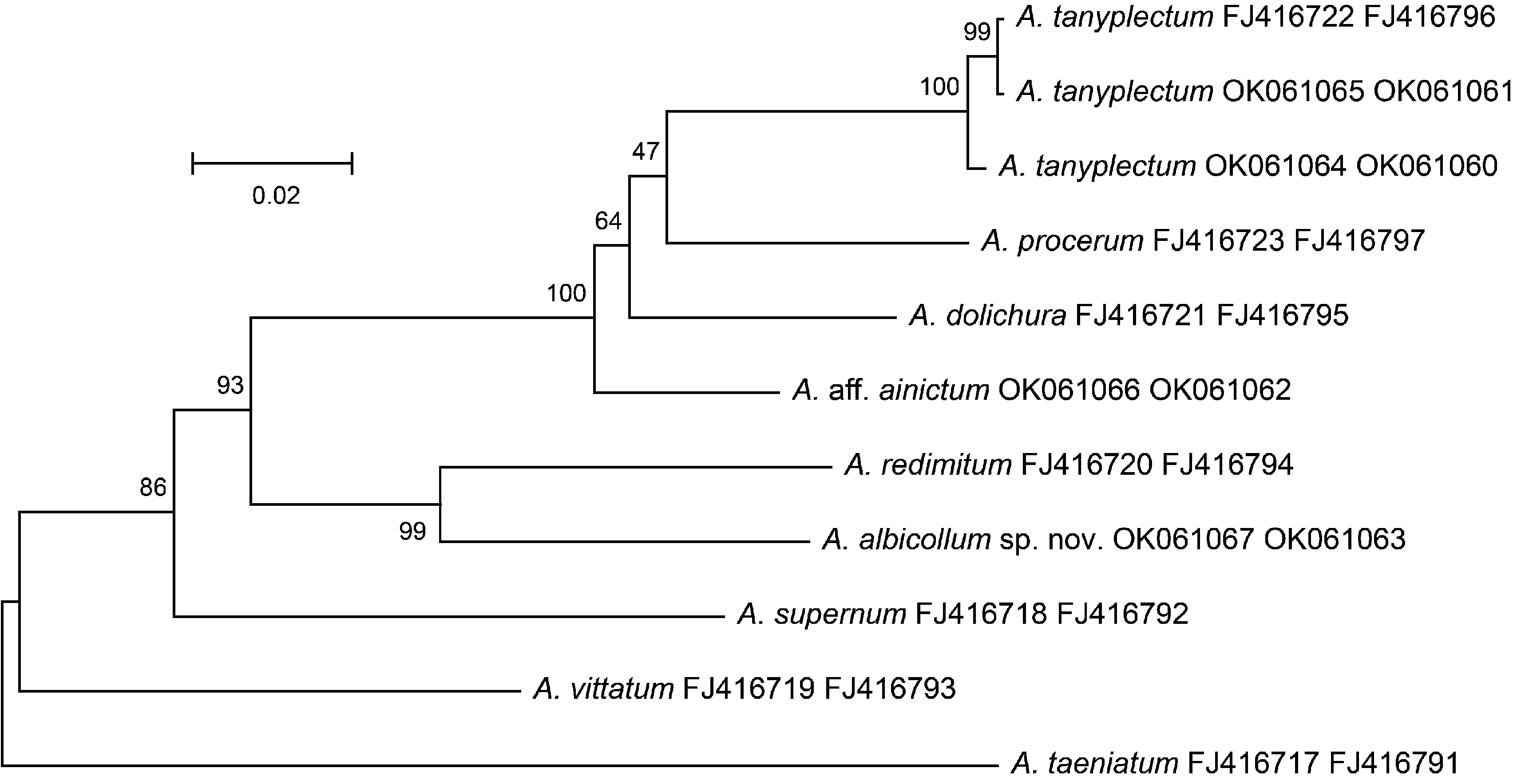
FIGURE 3 . Maximum-likelihood phylogeny of snakes of the genus Arrhyton from sequences of two mitochondrial genes (cytochrome b and ND4 ). Each species name is followed by GenBank accession numbers of the cytochrome b and ND4 genes, respectively. Voucher specimens are listed in Appendix 1. Numbers at nodes are bootstrap support values. The scale bar indicates 2% sequence divergence on a branch.

FIGURE 4 . Line-drawing of A. albicollum sp. nov. holotype (MNHNCu 6000) head in dorsal (A), ventral (B), frontal (C), and lateral (D) views. Scale bars = 2 mm.
Color in life ( Fig. 1A ): Dorsum gray to grayish-tan, with faint stripes. Each scale with somewhat darker pigmentation on the edge giving the overall dorsal region a net-like appearance. The neck band is immaculate white, and behind it there is a slightly darker, smoky-gray pigmentation that transitions to the dorsal color. Internasal scales with a dark spot on each. Another dark spot is present on each prenasal scale. First three supralabials and four infralabials stippled with dark brown. Rostral conical projection dark. Eye bicolored: upper half grayish-white; inferior half very dark brown, almost black. Venter paler than dorsum. A faint lateral stripe on scale row four, just defined by slightly darker pigmentation of scale borders, giving a serrated outline and bordered at the top by a narrow zone paler than the rest of the dorsum.
Color in alcohol (ten years after collection): similar to coloration in life, except that yellowish pigments completely disappeared. The faint stripes are even less obvious.
Distribution. Arrhyton albicollum sp. nov. is only known from the typeStatustype locality near the town of Gibara, ~ quantity36 km NNE from the city of collectingRegionHolguín in eastern collectingCountryCuba ( Fig. 5 ), but it probably occurs in suitable habitats between Bahía de Puerto Padre and Banes ( collectingRegionLas Tunas and collectingRegionHolguín Provinces, respectively).
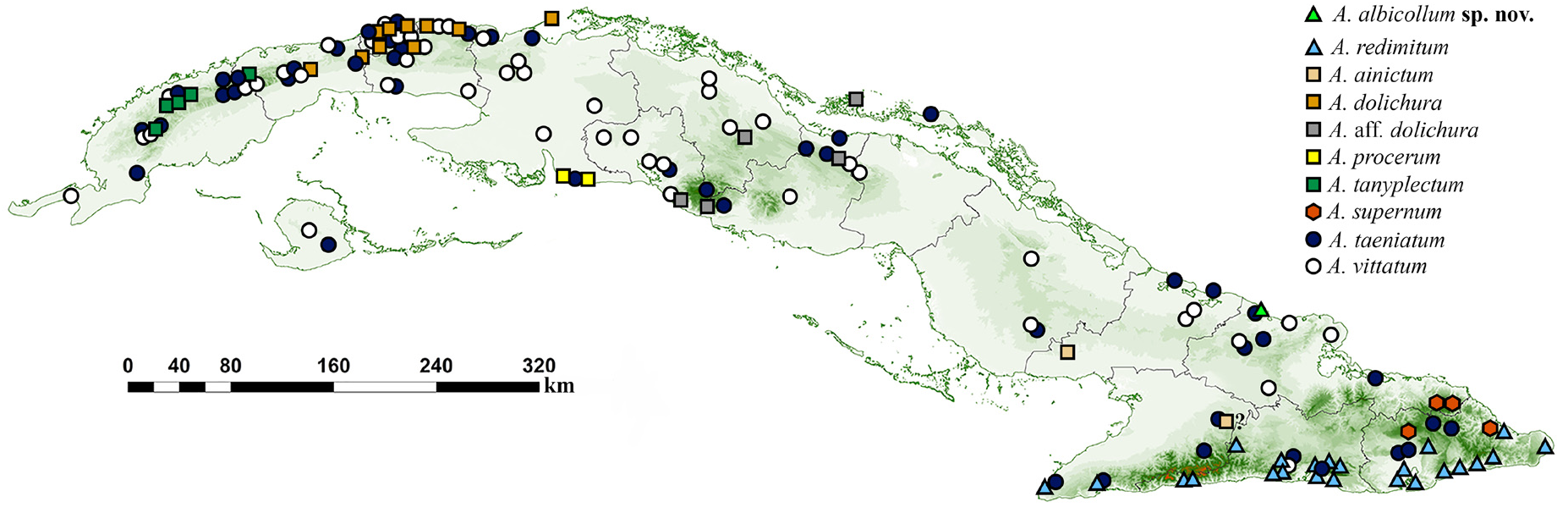
FIGURE 5 . Distribution of Arrhyton in Cuba. Localities, other than the type-locality of A. albicollum sp. nov. , are based on Rodríguez et al . (2013) , Cajigas & Velazco (2020), the authors’ visual records, and specimens listed in Appendix 1. See the Discussion for Arrhyton aff. ainictum (with question mark) and A . aff. dolichura .
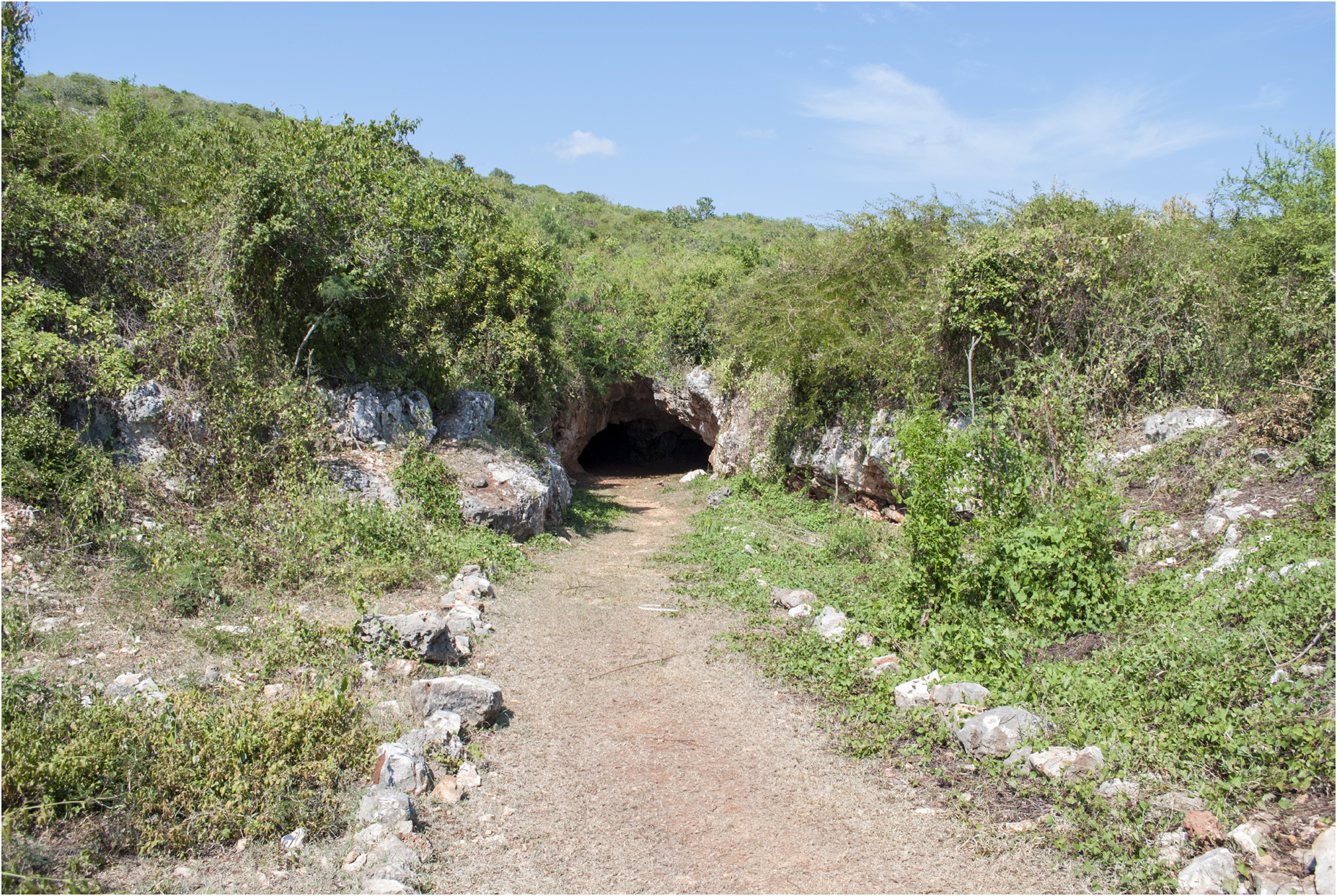
FIGURE 6 . Type locality of Arrhyton albicollum sp. nov. Cueva de los Panaderos at Gibara, Holguín Province. The degraded habitat comprised of grasses and spiny bushes (dominated by the invasive Dichrostachys cinerea ). Photo: Antonio Cádiz.
Habitat . The typeStatustype specimen was found under a pile of rocks at the entrance of Cueva de los Panaderos during the day ( Fig. 6 ). Caves and sinkholes are common structures in the area. The locality has patches of secondary semideciduous forest on limestone rock; however, the native vegetation is being displaced by the invasive spiny-bush Dichrostachys cinerea and the whole area is threatened by human use of caves and the trash dumping. Associated herpetofauna and complementary description of habitat is in Díaz et al . (2014) .
Etymology. The specific epithet is derived from the Latin words albus (white) and collum (neck), in reference to the conspicuous white neck band.
Proposed English name . Gibara White-collared Racerlet